uPVC vs Vinyl — As a Window Frame
🛑This is where the real performance difference shows up.
1️⃣ Multi-Chamber Design
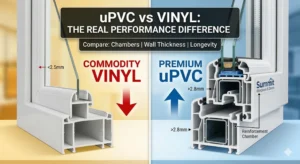
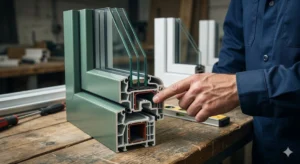
High-performance uPVC systems use multiple internal chambers.
Those chambers:
- Increase structural rigidity
- Slow thermal transfer
- Allow reinforcement placement
- Improve screw retention for hardware
Many commodity vinyl windows use simpler, fewer chamber designs. Less material. Less structure.
🔺More chambers = better insulation + better long-term dimensional stability.
2️⃣ Wall Thickness
➡️This is rarely talked about — but it should be.
Frame wall thickness directly impacts:
- Long-term resistance to warping
- Screw pull-out strength
- Hardware alignment over time
- Weld strength at the corners
- Overall lifespan
Thicker exterior walls (often 2.7–3.0mm+ in European systems) mean:
- Stronger welds
- Better rigidity
- Less deflection under load
- Longer service life
Thin-wall vinyl frames can perform initially — but over years of sun exposure, load, and movement, tolerances open up.
And when tolerances open up:
- Gaskets don’t seal the same
- Locks don’t align the same
- Air leakage increases
🔺The frame is the backbone of the window.
Glass performance doesn’t matter if the frame moves
The Bigger Picture
When comparing windows, ask:➡️➡️
- How many chambers are in the frame?
- What is the exterior wall thickness?
- Is there reinforcement?
- What locking system is used?
- How does the frame handle expansion and contraction?
Not all “vinyl” windows are engineered the same.
🔺Material formulation + profile design + wall thickness = longevity
And longevity is performance.
At Summit Windows & Doors, we manufacture European-style multi-chamber uPVC systems designed for structural stability, airtightness, and long-term performance — not just initial ratings.
If you’re designing or building projects where durability and envelope performance matter, let’s connect.